
We want robots to play.
A letter to the people building the athletic intelligence humanoids still need.
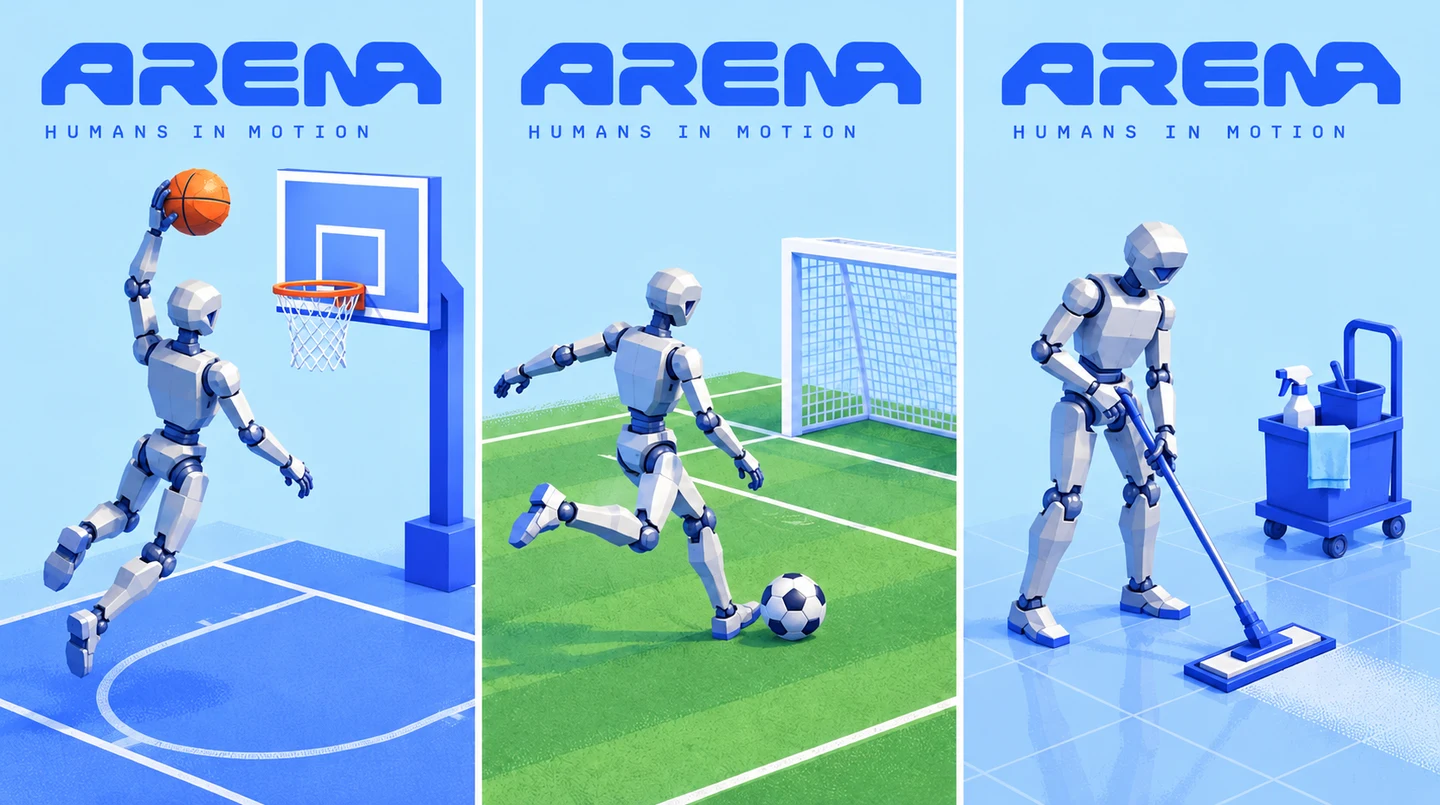
To everyone who believes robots should leave the lab,
Humanoids will not become useful because they learn one perfect demo. They will become useful when they can move through the physical world with range, judgment, recovery, and confidence. Sports make that problem visible. A throw, a rally, a dance, or a fighting stance asks a robot to perceive, coordinate, adapt, and commit, all in a language that anyone can understand.
That is why we are building Arena: a public place to turn an idea into a policy, a policy into a simulation, and a simulation into something worth trying on a real machine.
The gap between simulation and reality is where good-looking ideas are tested. Contacts change. Timing drifts. Motors saturate. Floors are less forgiving than pixels. We care about the entire path: honest simulation, reproducible training, visible evidence, hardware review, and supervised execution.
But that path should not be reserved for the few people who already have a robot lab. New Arena accounts start with free compute credits. Builders can use our datasets, challenges, AI setup prompts, and hosted machines to get moving quickly. If a project needs more compute or a closer path to hardware, we want it to be easy to ask.
A simulation is not disposable work. On Arena, it can become a public object: a video people can watch, a project they can inspect, and a result that stays connected to its builder. Sharing Sims lets the community see what is actually moving, learn from one another, and build on proof instead of claims.
The Robot Grant is one bridge forward. Exceptional work can earn funding and a route toward real-hardware evaluation. Other projects may begin with a challenge, a dataset, free compute, or simply a video that makes someone else want to try. The point is to make the next step visible and attainable.
Build something worth putting on a real robot. Show your work. Help us close the distance between what humanoids can do in simulation and what they can do in the world.
—HIM Robotics (Humans in Motion)